How to be more ambitious: A tutorial for humans with models
I work on Claude. It's an interesting experience: Every day I learn about yet another feat accomplished with or by Claude that I hadn't considered, didn't think possible, or simply lacked the curiosity and time to try. This month, it may have helped discover a new planet, I've seen the first AI music video that I really like, and we are discussing a new era of math.
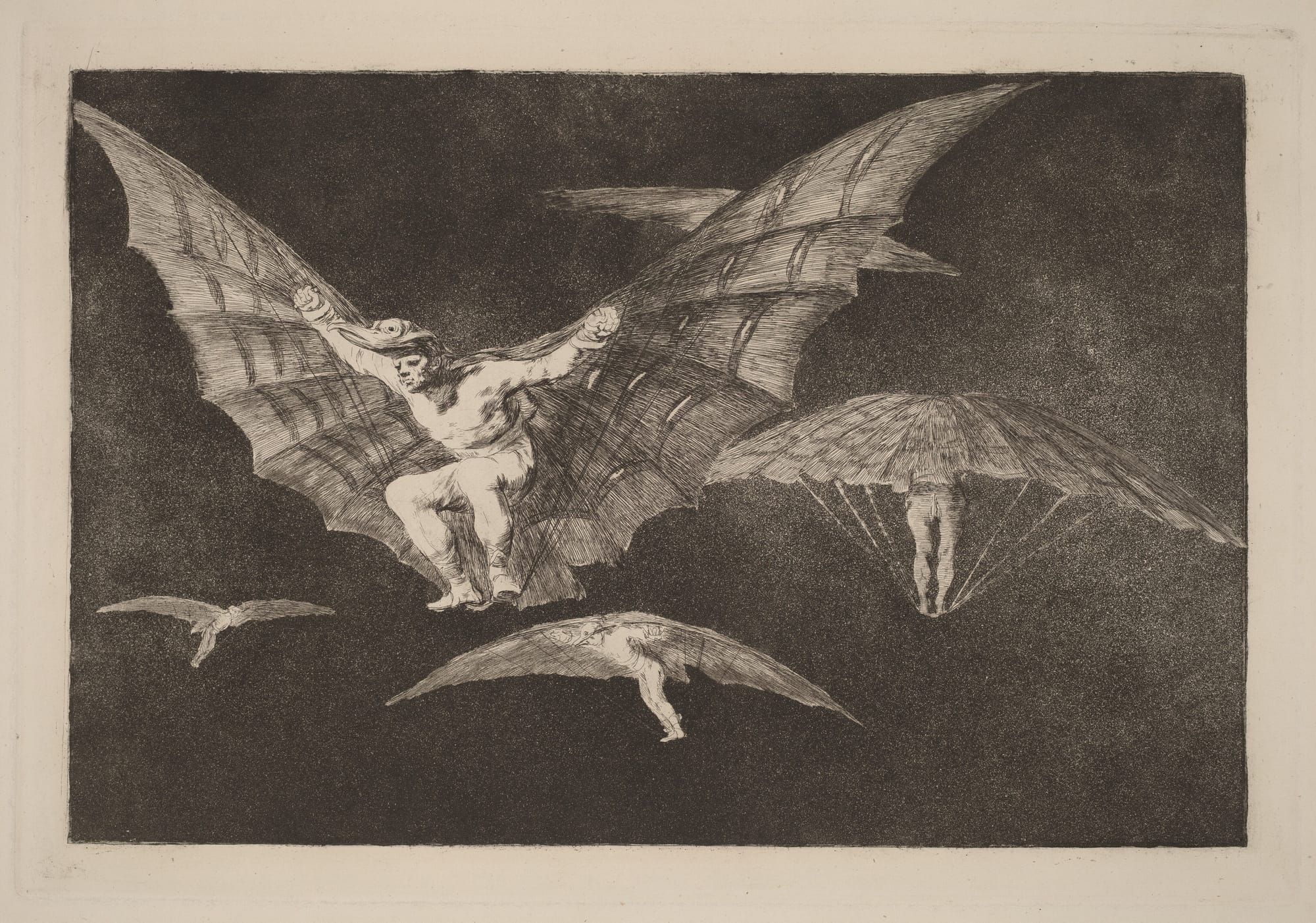
Model capabilities don't grow uniformly. Models are, as Terence Tao puts it, "astounding in some directions, while inadequate in others". Some people manage to pilot the astounding capabilities and seem to be flying - it's addicting to watch people reach incredible heights with the products I've built. Many others are still struggling to get their new wings to work, wondering what they're good for beyond asking "What is the capital of France" or "Can you make this email sound less angry".
I frequently proclaim (together with other people working on AI) that we ought to be more ambitious when using it. It's become a rallying cry. Whenever we see something impressive, we repost and write "we're not ambitious enough". I understand how tricky it is to follow that advice, so here's a tutorial on being more ambitious.
I think of ambition in four types: Speed, Altitude, Depth, and Range.
- Speed: The same work in less time, the bread and butter for AI's economic value: If you need some code written, I'll do it faster with Claude. Well established and requires little creativity in how you approach AI, so I'll skip this one.
- Altitude: Going up in abstraction and considering the outcome rather than the individual task.
- Depth: Considering a task the way a field-leading expert would. Rather than operating at the task's layer, we go one level deeper and touch the underlying data, tools, and problems.
- Range: Drawing on multiple fields rather than just the one the task might need at the surface, using knowledge, tools, and techniques you normally wouldn't.
I primarily use Claude (duh) but my advice is not model-specific.
Altitude
We often flippantly call this "letting the model operate at a higher abstraction". When you give the model a task, it's executing your best guess at how to get the outcome you want. To be more ambitious in altitude, ask yourself - what do you want to happen next? What's the goal beyond the goal? At the beginning of last year, I still asked Claude to fix individual crashes for me. Eventually I asked Claude to simply keep our apps crash-free.
Let's consider an everyday (dare I say mundane?) office task. You're at Acme Inc, an imagined company, where you need to put together a deck for the quarterly business review (QBR). Given a bunch of data, Claude will happily make you some slides. Maybe you even have a template and it just needs to fill it in. That's hardly comparable to finding a new planet, so let's look at some concrete steps to make our approach more ambitious. We'll start basic and get a little bit more ambitious with each step:
- As input, most reviews want to know what changed this quarter, why, and what should be done about it. Resist the urge to just update whatever numbers are in the template - give the model too as much data as you can get your hands on so it can understand your business: "Tell me what changed this quarter, why, and what we should do about it."
- Meetings (the good kind, anyway) ideally end with some decisions. Ask Claude: "Work out which three decisions are most urgent in the face of everything you've learned, and start working on potential directions with for/against arguments."
- QBRs are from a time when good reviews required humans to carefully sift through data, figure out what the data means, and if the business should adjust. Ask Claude: "The review exists so leadership catches problems early and moves money and people to the right places. Design a better way to do that than a quarterly deck, show from our own history that it would have caught things sooner, and run it beside the current one for a quarter."
The altitude approach works best if you really are after some ultimate outcome; it works less well for creative endeavors. A good tell-tale sign that ambition in altitude is a good idea is if you're going to have meetings to discuss whatever you're working on. There are currently limits ("Claude, go make money" doesn't seem to work for most businesses by itself in 2026), but I generally see that models seem to be able to operate at higher levels of abstraction the more capable they become.
Altitude is also where people find durable workflows that take the human out of the loop, making it less necessary for you to constantly update the model with task after task. Doing this well often involves changing your workflow - in order to let Claude make sure our app is crash-free, I first had to make sure it can easily fetch crash reports, understand which app version maps to what git commit, and give it access to Windows, macOS, and Linux computers so it can actually independently reproduce and verify fixes.
Depth
Sometimes, you just want a task executed really well. Being ambitious in depth means pushing the model to use the tools, techniques, media, and knowledge employed by the best professionals in the field - and to keep pushing until even those people might learn something new from your work.
Let's continue with our Acme Inc example of a quarterly business review deck. Assume for a second that Acme Inc struggles with some user churn (customer loss over time). I've found a mix of the following techniques useful:
- Insist on the same instruments used by the best in the industry: When prompted to act like a professional, models often switch vocabulary without actually switching methods. To work on our problem with depth, we need to use the same tools as the best data scientists and statisticians. When Claude reaches for markdown tables, insist on the use of databases and statistical models. You don't necessarily have to know what the experts use, Claude usually does.
- Pick unreasonable goals and tell the model that they're very reasonable: You need your website to load in 5s instead of 10s? Ask for 200ms. Does something seem impossible to the model? Reiterate that it's very much solvable, it just needs to keep going.
- Challenge what you know: Especially in business, a lot of things we believe to be true are rough approximations of reality. Give the model access to the raw information and data and ask it to adversarially check assumptions. "We believe churn is an onboarding problem. Try to reproduce that from the raw data."
- Produce new knowledge: Easily tacked onto challenging what you know - once Claude is already deep inside the data, ask it to find blind spots. "Build a simulation of our customers that reproduces the last year from our logs. Then find the earliest signal of churn we don't know about yet, and show it predicts on data it has not seen."
- Use an outside judge: Do not ask the model to judge itself. I assume that this will eventually be solved with increasing model intelligence, but in October 2026, I implore you to insist on outside validation. Ideally that's a tool the model can run to get feedback immediately.
A simple prompt that often helps me:
I want a deeper version of this task, not a bigger one. Before rewriting it: (1) say what a top professional in this field would do here that I'm not asking for; (2) name the rawest material they would start from instead of what has already been digested for me; (3) name the specific methods and tools they would use; (4) say what, other than you or me, would show the result is right. Then rewrite my prompt to ask for exactly that.
Range
In short, being ambitious in range means that we consider our work from the perspective of different fields - more fields than would have been economical in the past. This isn't a particularly unique insight, every single heist movie spends the first 30 minutes assembling a diverse cast of characters and talents. As AI products make it easier and easier to run multi-agent systems (with multiple threads, orchestrators, or simply subagents), I've seen really interesting results by imploring Claude to bring in additional fields.
Putting this into practice isn't easy; it requires you to be creative. Until I saw my colleague Alex Albert use Blender to render interior designs, I never considered using Claude for 3D environments for my homepage - even though I've previously made video games! However, this is easily where I see the most magic happen.
So, how do we do this? I use the following techniques:
- Try to replace the nouns with verbs: An old trick from The Art of Innovation by Tom Kelley and Jonathan Littman. A quarterly review isn't "a deck". It's "getting busy people to believe a story about cause and effect, and to decide under uncertainty, in 30 minutes". Having the verbs makes it easier for both me and Claude to understand which fields might bring in a unique and useful perspective.
- Assemble the crew: The deck needs to be amazing, otherwise aliens will blow up Earth. What kind of team will humanity get together? For production quality, I'd bring in an analyst, a journalist, and an editor. If it has to be presented, probably a motion and audio designer, too. It might be useful to employ an adversarial "red team", too, so let's bring in a short seller and a forensic accountant.
It is easy to accidentally engage in role play, which will make your transcript weirder without improving the actual outcome. Use this method to find fields and techniques. Don't ask the model to write a short seller, ask it to do what a short seller does to research their position.
All the ways in which I describe ambition require the model to have a computer with the ability to install software and access to all kinds of relevant data (either using MCP connectors or other means). Plenty of tools make this possible and I recommend that you use one.
We have been here before
That's my concrete advice for how to be more ambitious. If you're willing to stick around for a minute, I'd like to tell you why I think this is even necessary in the first place.
We humans have always been held back by what we believe possible - and what's worse, we usually trust ourselves only in very narrow disciplines. Michelangelo famously didn't want to paint the Sistine Chapel - you see, he was a sculptor, not a painter.
While researching the problem of ambition, I learned that psychology has a name for this: self-efficacy. In short, people with high self-efficacy believe in their own abilities more, and in turn actually accomplish more. There's evidence that self-efficacy can be hacked: Locke and Latham pored over 35 years of goal-setting research to confidently proclaim that humans who are given specific hard goals perform better than those who are simply told to try their best. Stripe founder Patrick Collison maintains a "Fast" list, chronicling the many things humans have accomplished when given both audacious goals and tight deadlines. Some hacks that are well documented:
- Accomplish hard things by believing them to be possible: In 1939, George Dantzig showed up late to a statistics class at Berkeley, copied two problems off the blackboard, and handed in his solutions thinking they were homework. They were two unsolved problems in statistics.
- Accomplish hard things after watching somebody else do them: For decades, humans chased the four-minute mile. Roger Bannister broke it in May 1954 but remained the only human to do so for a mere 46 days. If you're into running, we're watching something similar happen to the two-hour marathon: Sabastian Sawe ran the first official sub-two-hour marathon in London this April. In the same race, the runner-up also broke the two-hour mark.
- Accomplish hard things by giving yourself permission to fail: Apparently everyone's favorite business book is The Inner Game of Tennis, which I discovered just last week. The book's core thesis is that you're not playing your best game of tennis if you're trying really, really hard. We engineers might remember Linux, announced as "just a hobby, won't be big and professional like gnu".
Self-efficacy isn't a new problem, but it is a more powerful one now. In a world where our abilities make leaps every couple of weeks, we need techniques that allow us to do things we didn't really consider or believe possible. If you find more techniques that allow you to be more ambitious, please let me know!
The image for this post is by Francisco Goya, “Modo de volar” (A Way of Flying)